

BR24H256FJ-5AC
125℃-Betrieb I²C BUS EEPROM (2-Draht) für die Automobilindustrie
BR24H256FJ-5AC
125℃-Betrieb I²C BUS EEPROM (2-Draht) für die Automobilindustrie
Der BR24H256FJ-5AC ist ein serielles 256kbit EEPROM für die I²C BUS-Schnittstelle
Produktdetails
Funktionalen Sicherheit:

Spezifikationen:
Series
BR24H-5AC
Density [bit]
256K
Bit Format [Word x Bit]
32K x 8
Vcc(Min.)[V]
1.7
Vcc(Max.)[V]
5.5
Circuit Current (Max.)[mA]
1.7
Standby Current (Max.)[μA]
10
Write Cycle (Max.)[ms]
3.5
Input Frequency (Max.)[Hz]
1M
Endurance (Max.)[Cycle]
4x10⁶
Data Retention (Max.)[Year]
100
I/F
I2C BUS(2-Wire)
Operating Temperature (Min.)[°C]
-40
Operating Temperature (Max.)[°C]
125
Package Size [mm]
4.9x6.0 (t=1.65)
Common Standard
AEC-Q100 (Automotive Grade)
Eigenschaften:
- AEC-Q100 Qualified (Grade 1)
- All Controls Available by 2 Ports of Serial Clock (SCL) and Serial Data (SDA)
- 1.7V to 5.5V Wide Limit of Operating Voltage, Possible 1MHz Operation
- Page Write Mode 64Byte
- Bit Format 32K x 8bit
- Low Current Consumption
- Prevention of Miswriting
WP (Write Protect) Function Added
Prevention of Miswriting at Low Voltage - Noise Filter Built-in SCL/SDA Pin
- Initial Delivery State FFh
Referenzdesign / Anwendungsevaluierungskit
-
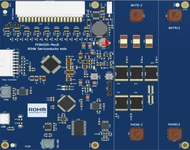
- Reference Design - REF68008
- Industrial 16-Cell BMS Evaluation Platform with ML5238GA AFE and ML63Q8057 MCU
This Battery Management System (BMS) platform provides detailed specifications for an industrial-grade lithium-ion battery monitoring and protection solution. It is designed to support reliable operation in demanding industrial energy storage and power backup applications.
The BMS evaluation platform serves as a reference design for assessing a multi-cell battery monitoring system utilizing ROHM’s ML5238 16-cell Analog Front End (AFE) in combination with the LAPIS ML63Q8057 microcontroller. The system enables accurate cell voltage measurement, current sensing, temperature monitoring, cell balancing, state-of-charge estimation, and fault detection, forming a complete solution for industrial battery packs.
This evaluation kit integrates the core functional blocks required for BMS operation, including the monitoring circuitry, control firmware, sensing interfaces, non-volatile memory, and PC communication interface. The design is optimized for robustness, measurement accuracy, and long-term reliability, making it suitable for industrial energy storage systems, uninterruptible power supplies (UPS), e-mobility auxiliary systems, and stationary battery applications.
The reference design includes comprehensive technical resources such as firmware architecture documentation, communication protocol definitions, memory maps, and configuration guidelines. It features a fully functional BMS firmware implementation optimized for industrial environments, supporting protection mechanisms, data logging, diagnostics, and seamless interfacing with a host PC or supervisory controller.
Users are encouraged to explore the advanced monitoring, protection, and diagnostic capabilities of this BMS evaluation platform and consider its integration or customization for their industrial battery management and energy storage development projects.
