

BD9E303EFJ-LB(E2)
7,0 V bis 36 V Eingangsleistung, 3,0 A Synchron-Buck-Wandler DC/DC-Wandler mit Integriertem Einzel-MOSFET
BD9E303EFJ-LB(E2)
7,0 V bis 36 V Eingangsleistung, 3,0 A Synchron-Buck-Wandler DC/DC-Wandler mit Integriertem Einzel-MOSFET
Für das Produkt wird ein Langzeit-Support im industriellen Markt garantiert. Der BD9E303EFJ-LB(E2) ist ein synchroner Abwärtswandler mit integrierten Leistungs-MOSFETs. Der DC/DC-Wandler zur Steuerung des Strommodus zeichnet sich durch ein Hochgeschwindigkeitseinschwingverhalten aus. Auch die Phasenkompensation ist leicht einstellbar. A Product Change Notice (PCN) is scheduled for this product.
While there will be no changes to electrical characteristics, certain specifications will be updated.
If you would like evaluation samples, please contact your sales representative or use the "Contact Us" form.
Produktdetails
Spezifikationen:
ch
1
Integrated FET / Controller
Integrated FET
Topology
Buck
Synchronous / Nonsynchronous
Synchronous
Vin1(Min.)[V]
7
Vin1(Max.)[V]
36
Vout1(Min.)[V]
1
Vout1(Max.)[V]
28.8
Iout1(Max.)[A]
3
SW frequency setting (Max.)[MHz]
0.3
Light Load mode
No
EN
Yes
PGOOD
No
Operating Temperature (Min.)[°C]
Tj=-40
Operating Temperature (Max.)[°C]
Tj=150
Package Size [mm]
4.9x6.0 (t=1.0)
Eigenschaften:
- Long Time Support Product for Industrial Applications.
- Synchronous single DC/DC converter.
- Over-Current Protection.
- Short Circuit Protection.
- Thermal Shutdown Protection.
- Under voltage Lockout Protection.
- Soft Start.
- HTSOP-J8 package (Exposed Pad).
Referenzdesign / Anwendungsevaluierungskit
-
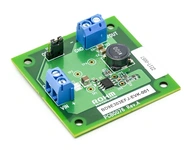
- Evaluation Board - BD9E303EFJ-EVK-001
This EVK is using not BD9E303UEFJ-LB, but BD9E303EFJ-LB. BD9E303EFJ-EVK-001 Evaluation board delivers an output 5.0 volts from an input 7.0 to 36 volts using BD9E303EFJ-LB, a synchronous rectification step-down DC/DC converter integrated circuit, with output current rating of maximum 3A. The output voltage can be set by changing the external parts of circuit and the loop-response characteristics also can be adjusted by the phase compensation circuit.
